
 English
  Nederlands
Across Iraq: Locally-Led Group Tour 2027
Every other month departure in 2027!
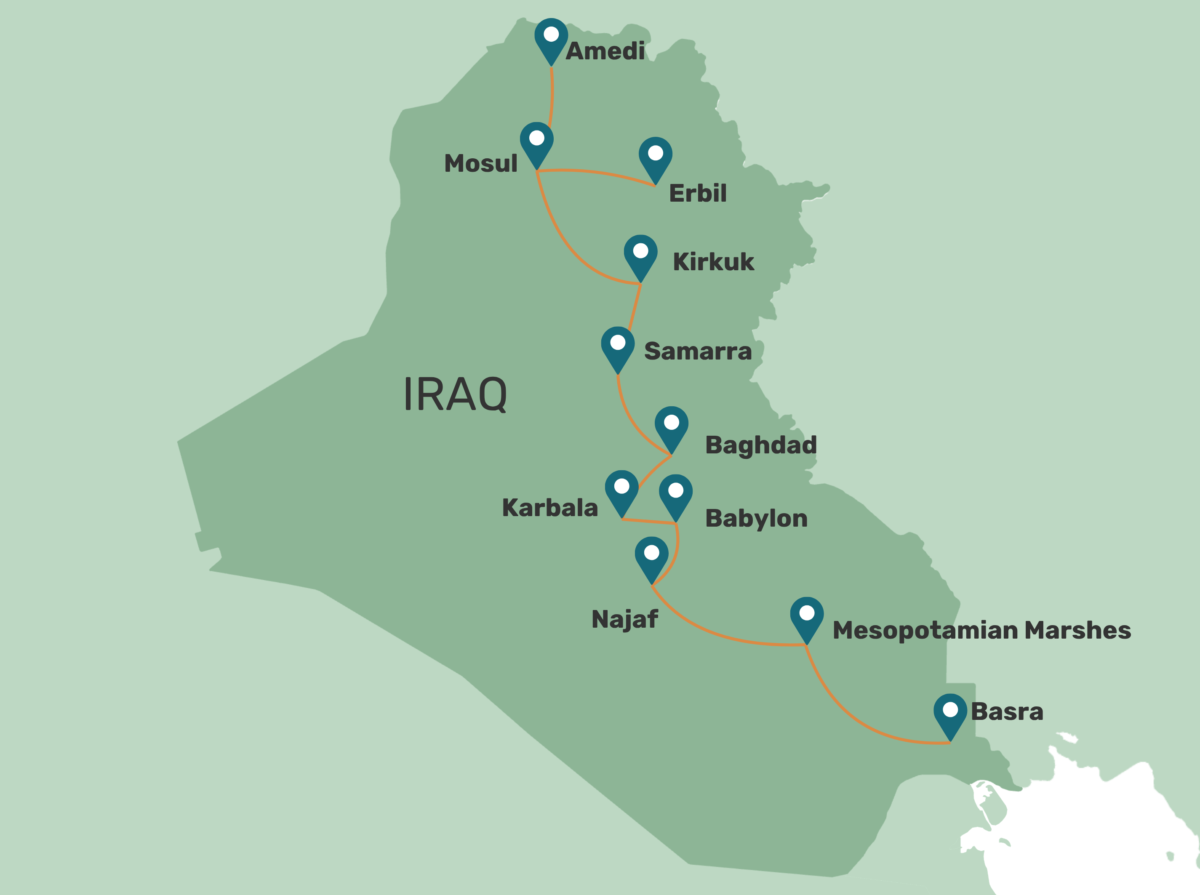
This locally-led group tour takes you in 5 or 10 days from the south into the north. The route combines well-known highlights with places outside standard itineraries. You travel with local guides who know the country from the inside, giving you more context for what you see.
You start in Basra, travel through the Mesopotamian Marshes and past the ancient cities of Ur and Uruk, continue to the holy cities of Najaf and Karbala and historic Baghdad, and end in the mountains of Iraqi Kurdistan near Erbil.

Departures (every other month)
| Date | Group | Status |
|---|---|---|
| 5 – 9 January 2027 | Group A – 5 days | Book now |
| 5 – 14 January 2027 | Group B – 10 days | Book now |
| 5 – 9 March 2027 | Group A – 5 days | Book now |
| 5 – 14 March 2027 | Group B – 10 days | Book now |
| 5 – 9 May 2027 | Group A – 5 days | Book now |
| 5 – 14 May 2027 | Group B – 10 days | Book now |
| 14 – 19 July 2027 | Arbaeen Walking Tour | Book now |
| 14 – 23 July 2027 | Arbaeen Walking Tour | Book now |
| 5 – 9 September 2027 | Group A – 5 days | Book now |
| 5 – 14 September 2027 | Group B – 10 days | Book now |
| 5 – 9 November 2027 | Group A – 5 days | Book now |
| 5 – 14 November 2027 | Group B – 10 days | Book now |
General info
| Days | 5 or 10 days |
| Price | 5 days – € 1,545 10 days – € 2,995 |
| Including | Accommodation (shared) Transportation on the ground English speaking local guide Daily breakfast Entry fees |
| Excluding | International flights Single room (for 5-day tour = € 200) Single room (for 10 day-tour = € 450) Insurance Visa (€200) Lunch & Dinner Tips for the guide Personal expenses |
This offer is covered by the STO Garant guarantee. You can find the conditions for this guarantee scheme on STO Garant’s website.
Itinerary
Day 1 – Basra
Arrival in Basra, the gateway to southern Iraq, with an airport pick up. Depending on your route, you may travel via Istanbul, Amman, Qatar or Dubai.
After the airport pick-up, we transfer to the hotel. If arrival times allow, we take a short walk along the Shatt al-Arab, the river formed by the meeting of the Tigris and Euphrates. Basra has long been one of Iraq’s most important trading ports and still has a distinct southern, Gulf-facing atmosphere.
Overnight stay in a hotel in Basra.
Day 2 – Basra – Marshes
After breakfast, we explore Basra’s old city. We visit the historic Ashar and Shanashil area, known for its traditional merchant houses and wooden balconies. See the confluence of the Euphrates and the Tigris river, next to it is the Tree of Adam & Eve.
From here, we continue by boat on the Shatt al-Arab. During this boat trip, we will see several shipwrecks from the Iran-Iraq War from the 1980s.
Later we leave the city and drive towards the Mesopotamian Marshes. In the marshes, we travel by traditional boat through the reed channels to see the ‘floating villages’. We also see local communities who still live from fishing, buffalo herding and reed-house traditions.
Overnight stay and dinner (traditional dinner – Masgouf) in a guesthouse in the Mesopotamian Marshes.
Day 3 – Marshes – Ur – Uruk – Najaf
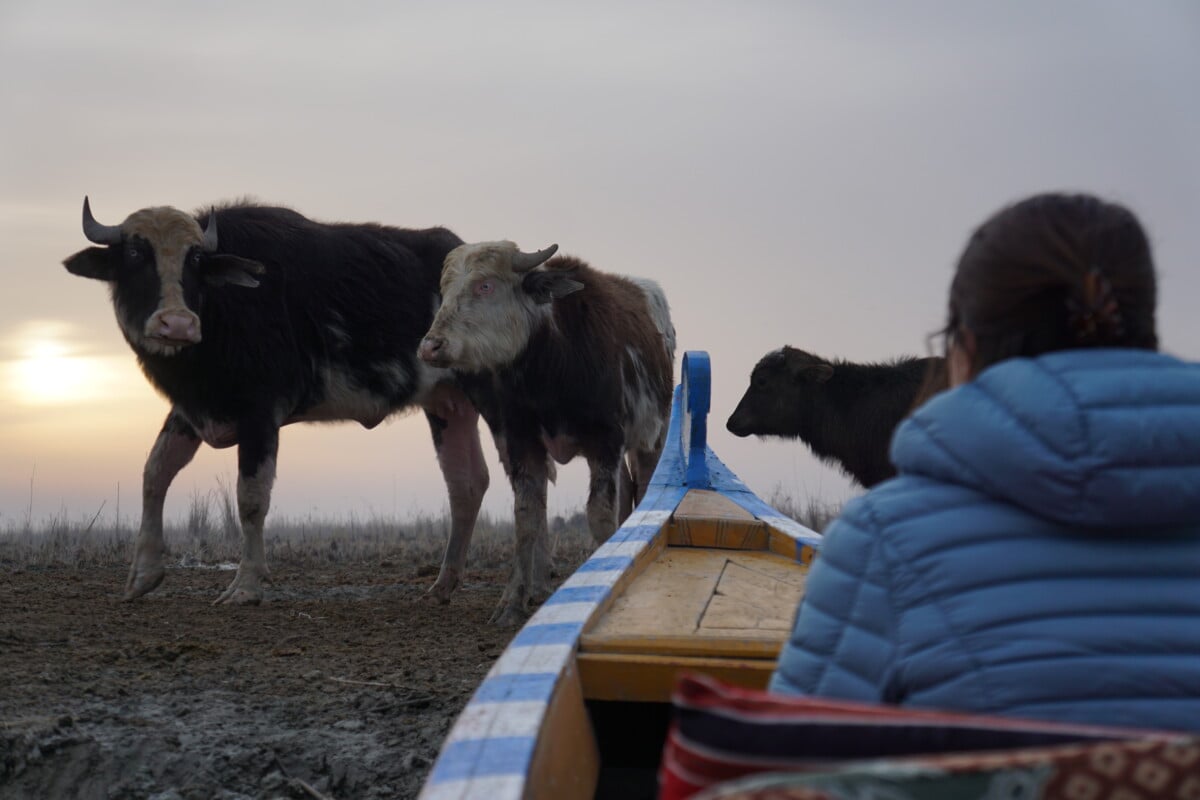
We start early with a sunrise boat ride through the wetlands. Where we see buffalos swimming and birds waking up all around you – with a good chance of spotting a kingfisher.
When we come back from the boat trip, we enjoy a very local breakfast, often with buffalo milk and cream from the same herds you just saw in the wild, served with freshly baked traditional bread.
Afterwards, we drive to Ur, one of the great cities of ancient Sumer and famous for its impressive ziggurat. Ur is also traditionally associated with the prophet Abraham. We then continue to Uruk, often described as one of the world’s first true urban centres and closely linked to the early development of writing and complex city life.
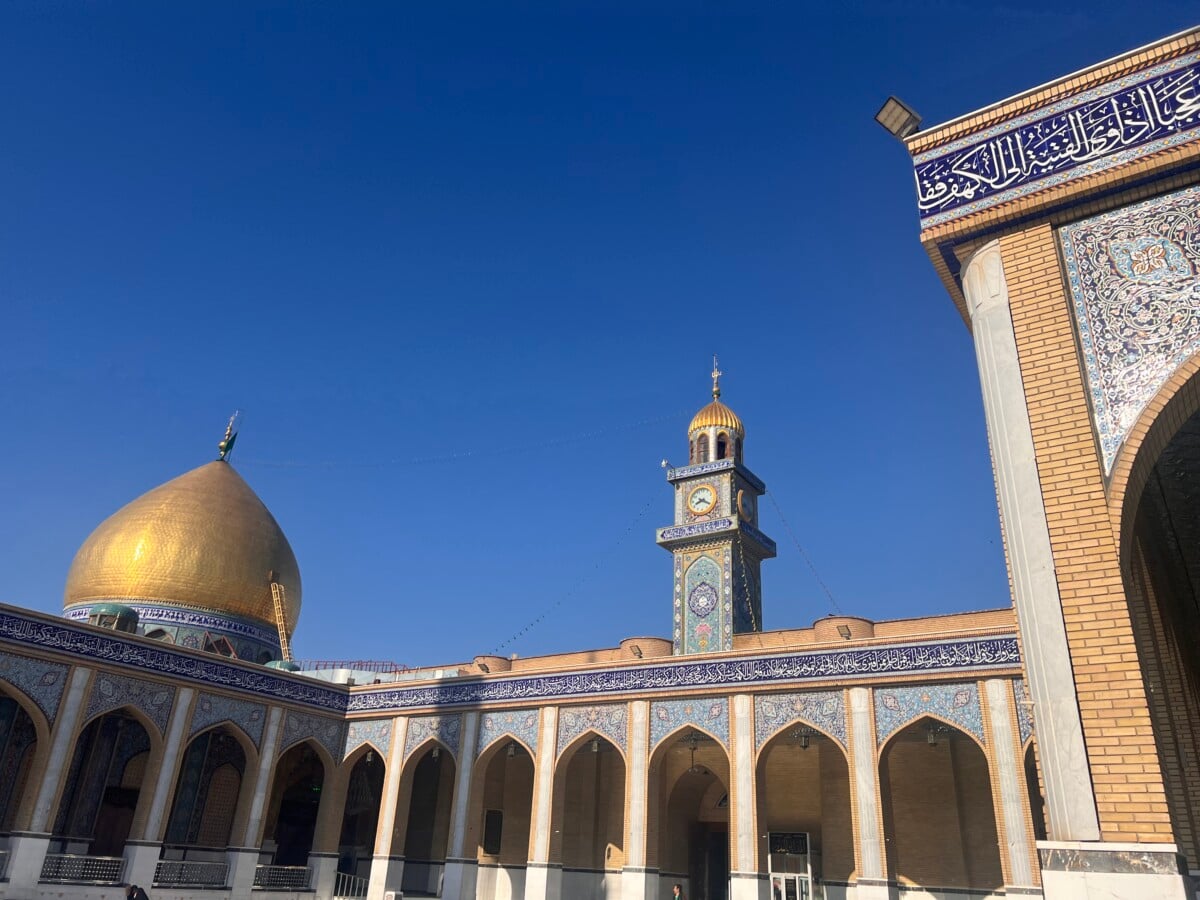
In the late afternoon, we drive to Najaf, the third holiest city in Shia Islam. In Najaf we provide abayas for all women in the group.
In the evening, we make our first visit to the area around the Imam Ali Shrine, including the shrine itself. We wander through the nearby bazaar, try Najaf’s famous sweet daheen, and browse local goods such as kuffiyehs and other traditional items.
Overnight stay in a hotel in Najaf.
Day 4 – Najaf – Babylon – Karbala
This morning we visit Kufa Mosque, which is one of the oldest mosques in the world. We will also visit Wadi al-Salam, the world’s largest cemetery with over 6 million people buried. It draws millions of pilgrims each year.
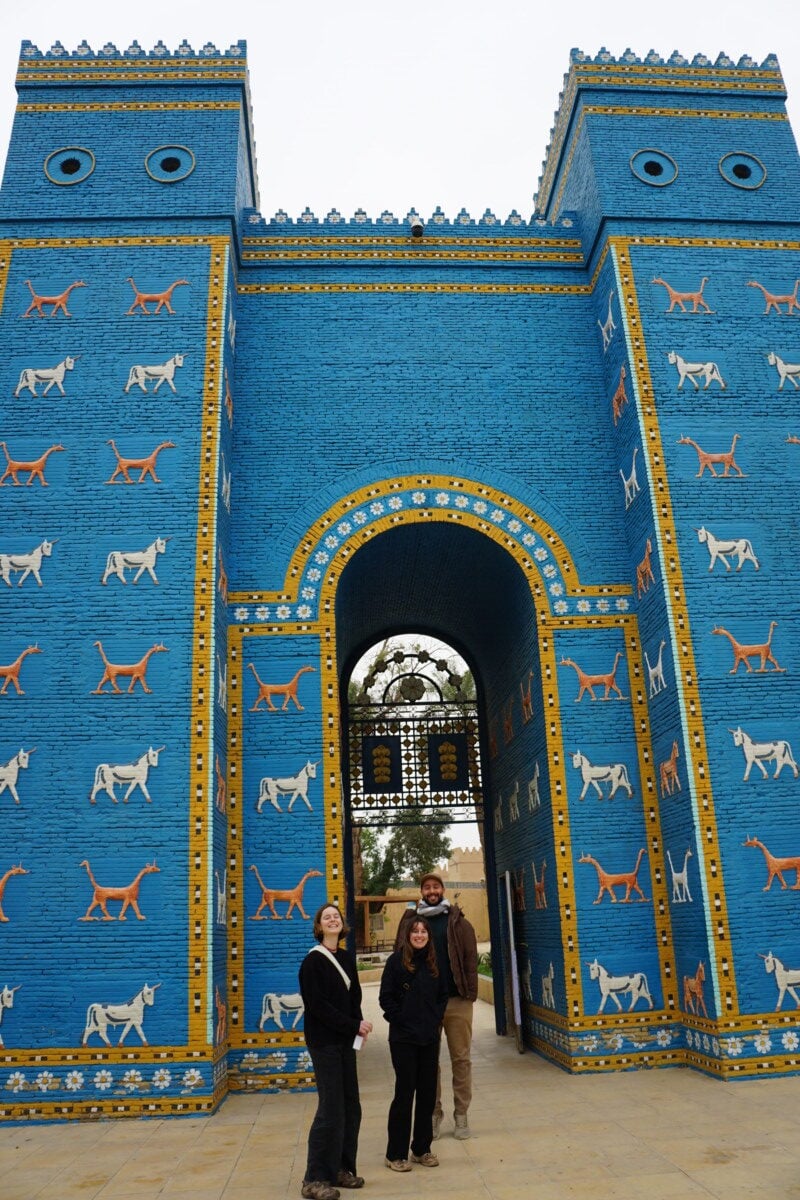
We then continue north to Babylon. Once one of the most powerful cities of the ancient world, Babylon is linked to Hammurabi, Nebuchadnezzar II and the legendary Hanging Gardens. Today, the site includes original ruins, a replica of the Ishtar Gate (the original is in Berlin) and reconstructed sections. If we get the special access, we visit Saddam Hussein’s abandoned palace above Babylon with one of his former staff.
Later we drive to Karbala, one of the most important pilgrimage cities in the Islamic world. Also here we provide abayas for all women in the group. We visit the shrine area of Imam Hussein and Al Abbas Mosque, where the atmosphere is especially powerful in the evening.
Overnight stay in a hotel in Karbala.
Day 5 – Karbala – Baghdad
After breakfast, we drive to Baghdad (approximately 2 hours), Iraq’s capital and one of the most historically important cities in the Middle East.
We will stop on the way to take a look at Ctesiphon. This old, gigantic brick arch is under construction, but still an impressive sight to see. Opposite stands the Panoramic Ctesiphon building, which was used as a fort during the ISIS war. Inside, we’ll go to the rooftop, where bullet shells, holes, and debris still remain.
Today marks the end of Group A. We can arrange a hotel drop-off in Baghdad or a transfer to the airport, depending on your departure plans. If you have a late flight, you can join an optional city tour of Baghdad. An extra hotel night can also be arranged if needed.
We start with our city tour through Baghdad the Mutanabbi Street, the heart of Baghdad’s literary culture, followed by the nearby Al-Mustansariya School, one of the oldest universities in the Islamic world.
We continue into the old market areas, including the Al Safafeer copper market, which has been active since the 9th century and reflects traditional craftsmanship and daily trade. Along the Tigris we visit Tahrir Square and the Freedom Monument, and depending on timing also Firdos Square, known for the toppling of Saddam Hussein’s statue in 2003.
We end the day with key memorials and modern landmarks, including the Al Shaheed Monument, the Victory Arch and the Unknown Soldier Monument, offering insight into Iraq’s recent history.
Overnight stay in a hotel in Baghdad.
Day 6 – Baghdad – Samarra – Kirkuk
We leave Baghdad and stop at the ziggurat of Aqar Quf, the site of ancient Dur-Kurigalzu. Its large ziggurat rises dramatically from the flat landscape and gives a strong first impression of Iraq’s ancient heritage north of the capital.
We continue to Samarra, on the way we drive through villages that have been destroyed in the fight against IS. See the Samarra Minaret (also known as the Great Mosque of Samarra). If you like you can walk to the top. Access can change depending on restoration work and local regulations, but even from outside the scale of the site is impressive.
By evening, we arrive in Kirkuk, one of Iraq’s most diverse cities, with Kurdish, Arab, Turkmen, Assyrian and other communities. We aim to organise a private dinner with local residents from different backgrounds, offering insight into the city’s layered identity.
Overnight stay in a hotel in Kirkuk.
Day 7 – Kirkuk – Hatra – Mosul
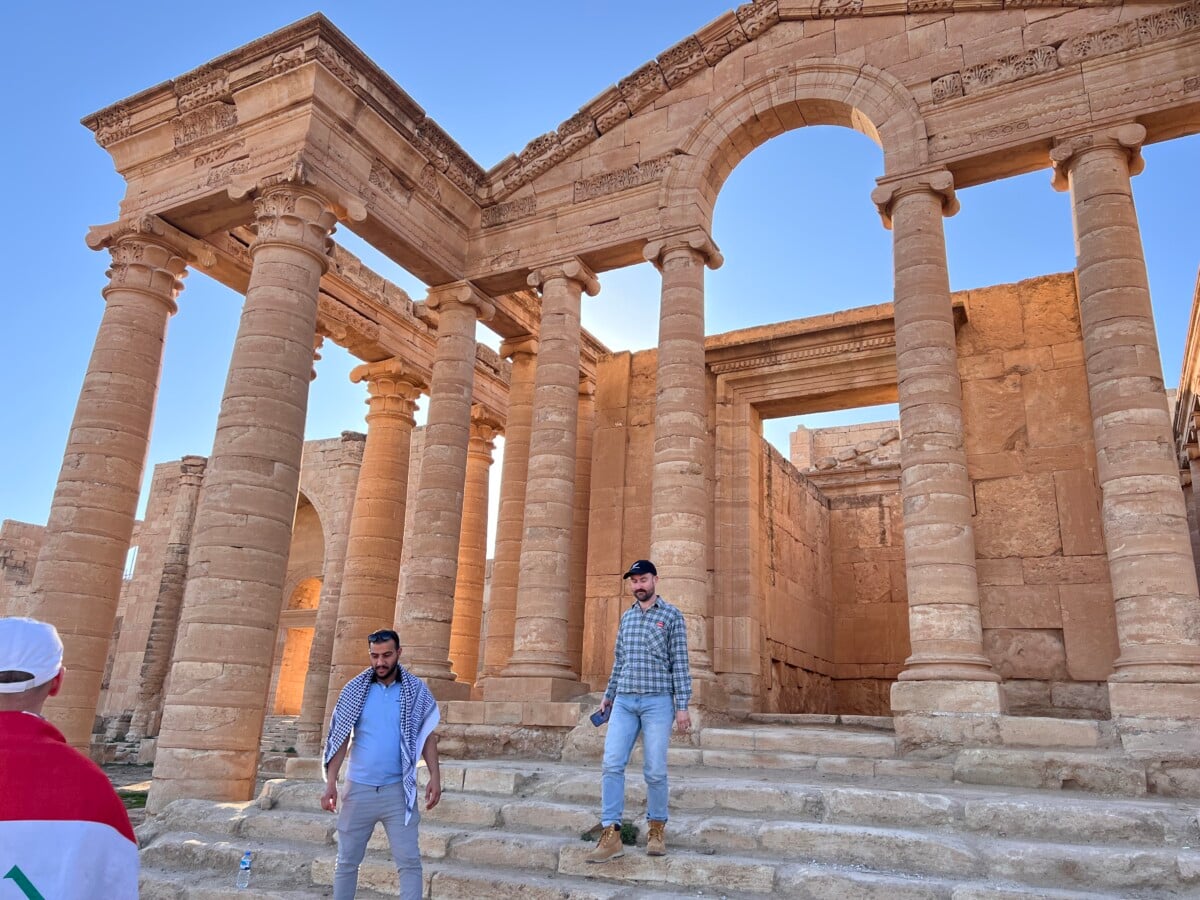
Today we drive west towards Hatra, a UNESCO World Heritage site and ancient desert city dating back to the Parthian era. Known for its massive defensive walls and well-preserved temples, it once served as an important religious and trading centre between the Roman and Persian worlds.
In the afternoon we continue to Mosul. In 2014 the city was captured by ISIS and reclaimed again by the Iraqi forced in 2017. A lot of buildings are under destruction, UNESCO and the locals are trying to rebuild everything again.
Overnight stay in a hotel in Mosul.
Day 8 – Mosul – Nineveh – Lalish – Amedi
We spend the morning exploring Mosul further. We visit the Al-Nuri Mosque, one of the most important landmarks of the city. The mosque has been fully rebuilt and is now open again, and if time allows, we can enter to see the reconstruction. We visit parts of the old city, like reconstruction areas, local bazaars, the Church of Mar Toma (also recognized as St. Thomas) and the Al Tahira Church.
After the city tour, we will go to the old city walls of Nineveh in Mosul. Today, only parts of the old city walls and fencing are visible, marking one of the most important archaeological sites in the region and once the capital of the Assyrian Empire. We explore the surroundings and get a sense of the scale and history of this once-legendary city.
We then drive north to Lalish, the spiritual centre of the Yazidi community. Visitors must dress modestly and remove their shoes before entering the sacred valley. Lalish is the holiest Yazidi temple complex and houses the tomb of Sheikh Adi ibn Musafir.
Afterwards, we continue to Amedi (also known as Amadiye), a spectacular old town set on a mountain plateau. Its location, old gate and mountain views make it one of the most scenic stops in Iraqi Kurdistan.
Overnight stay in the mountain area of Amedi.
Day 9 – Amedi – Barzan – Rawanduz
Today is one of the most scenic days of the tour. We drive through the mountains of Iraqi Kurdistan, with stops in the Barzan area, which is known as the historic home of the Barzani family, an important name in modern Kurdish history. Here we visit the Barzani Memorial Center, which provides insight into the history of the region and the Barzani family’s role in it.
On the way to Rawanduz, we stop at Shanidar Cave, an important archaeological site where remains of early humans were discovered. Here we learn about its history while surrounded by dramatic mountain scenery.
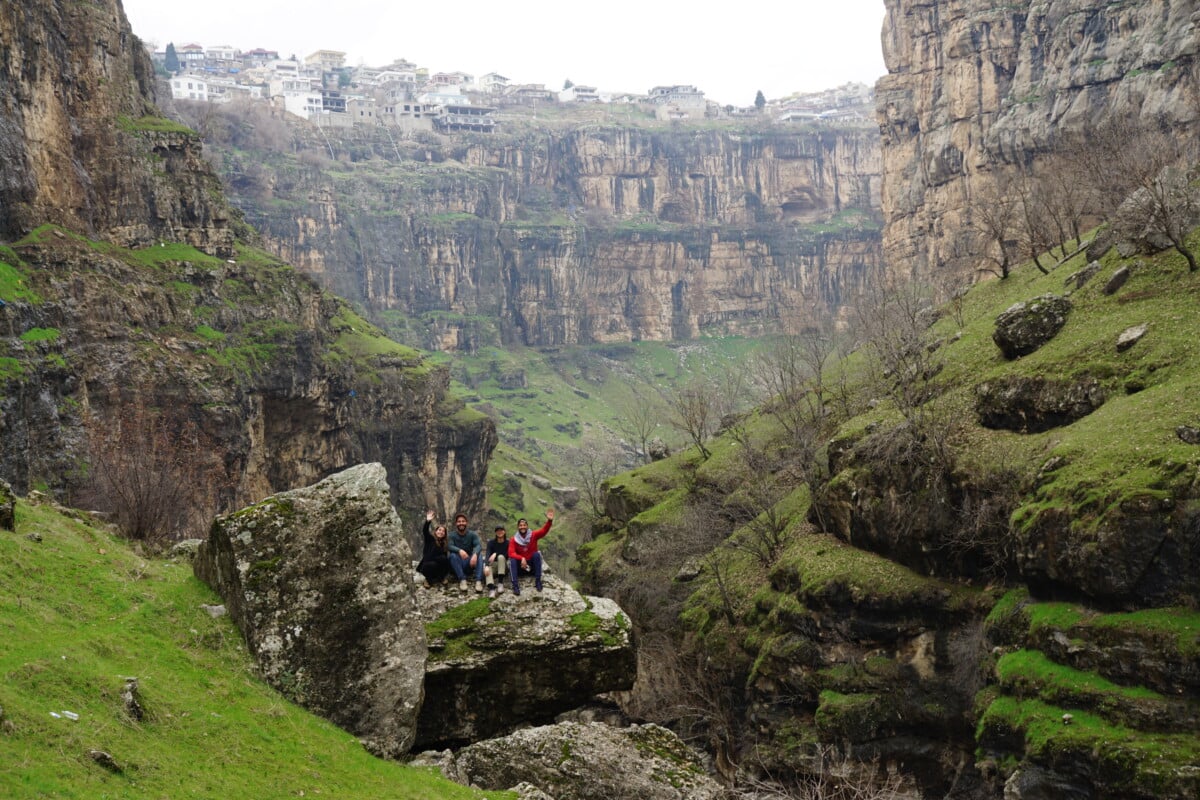
We then continue along parts of the historic Hamilton Road. Built in the early 20th by British engineer Sir Archibald Hamilton, known for its dramatic mountain scenery and gorges. We make photo stops along the way and, if conditions allow, visit viewpoints over Rawanduz Canyon. This day shows a very different side of Iraq: cooler air, mountain villages, green valleys and a strong Kurdish identity.
Overnight stay in a hotel in Rawanduz.
Day 10 – Rawanduz – Gali Ali Beg Waterfall – Mount Korek – Erbil
After breakfast, we continue through the mountains. We visit Gali Ali Beg Waterfall, one of the best-known natural landmarks in Iraqi Kurdistan, located along the historic Hamilton Road area. We may also stop at Bekhal Waterfall, depending on timing and road conditions.
Afterwards, we continue towards Mount Korek for panoramic mountain views, before driving to Erbil. In Erbil, we visit the ancient Citadel, a UNESCO World Heritage Site built on a large settlement mound that dominates the city. UNESCO describes it as a fortified settlement with layers of earlier occupation beneath the current citadel structure.
The tour ends in Erbil. Depending on flight schedules, travellers can depart in the evening or stay an extra night, which we can arrange.
Ready for another adventure? This journey connects perfectly with our Syria group tour, which has monthly departures, starting on the 15th. A direct Royal Jordanian flight (RJ821) departs Erbil at 20:30 to Amman, where we can arrange onward transfer to Damascus the next day.